

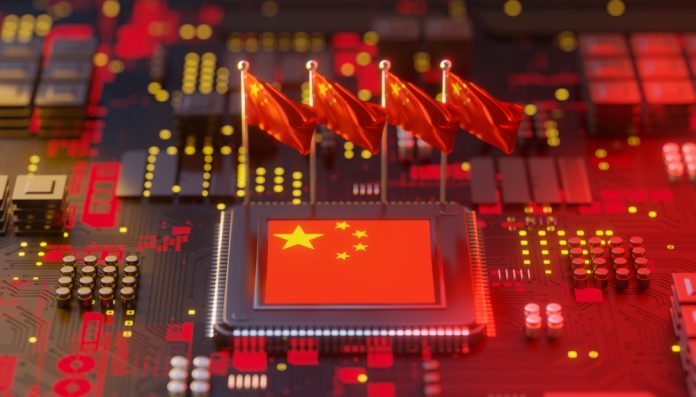

Imagine ancient mapmakers marking “Here be dragons” on uncharted territories. Today, that same sense of the unknown surrounds China’s emerging AI chipmakers – companies like Biren Technology, Moore Threads, and MetaX that have seen their valuations soar on investor optimism. But as these “dragons” breathe fire on stock exchanges, the real question is whether their firepower is mythical or substantial.
The Dragon’s Roar: Explosive Valuations
Last week, Biren Technology’s shares surged 76% on its Hong Kong IPO, raising over $700 million. Just last month, Moore Threads and MetaX leapt 425% and nearly 700% respectively on their debuts, collectively raising $1.7 billion. Even search giant Baidu saw a 15% jump after announcing plans to spin off its chip unit. This frenzy isn’t just about AI’s potential – it’s fueled by geopolitics.
When the Trump administration halted Nvidia’s H20 chip exports to China last year, Beijing responded by boosting funding for domestic production and encouraging local purchases. Bernstein analysts now predict China’s domestic chip market share will reach 53% this year, up from just 29% in 2024 before Nvidia’s restrictions. That translates to revenue potentially quintupling to $29 billion.
The Reality Check: Scale and Sustainability
But here’s the rub: none of these newly public chipmakers has sales worth more than a tenth of their bigger listed rival, Cambricon. Huawei alone commanded a whopping one-fifth of China’s AI chip market in 2024, while no other domestic player managed even 1%. The recent excitement has left Cambricon and Biren with enterprise values at a stunning 40-plus times their projected 2026 sales – compared to Nvidia’s peak forward multiple of 24 last year.
“Think of China’s 130-odd electric-vehicle makers, or its myriad solar-panel makers before that,” warns the Financial Times analysis. “Today’s dragon may turn out to be tomorrow’s newt.”
The Global Context: Nvidia’s Balancing Act
While China’s domestic players surge, Nvidia faces its own challenges in the market. According to TechCrunch, Nvidia is now requiring Chinese customers to pay upfront in full for its H200 AI chips – no refunds or order changes allowed – even as approval from both U.S. and Chinese authorities remains uncertain. This comes after Nvidia suffered a $5.5 billion inventory write-down due to previous export restrictions.
Yet demand remains strong: Chinese companies reportedly placed orders for over 2 million H200 GPUs in 2026, prompting Nvidia to ramp up production. At CES 2026, Nvidia CEO Jensen Huang expressed confidence in continued Chinese demand, noting that while the H200 “won’t be competitive forever,” the upcoming Rubin platform “will be available in China ‘in time.'”
The Memory Boom: Samsung’s AI Windfall
Meanwhile, the AI boom is creating winners beyond chip designers. Samsung Electronics just forecast record quarterly earnings, with operating profit tripling to about $13.8 billion and revenue increasing 23% to 93 trillion won. The driver? Surging demand for high-bandwidth memory (HBM) chips used in AI hardware.
Samsung’s chair Lee Jae-yong has been meeting with industry leaders like Nvidia’s Jensen Huang to strengthen partnerships, and analysts predict Samsung will supply Nvidia with its advanced HBM4 chips for the Vera Rubin platform. “The memory shortage is unlikely to abate even in 2027,” notes Daniel Kim, Head of Korea Research at Macquarie Capital, projecting Samsung’s HBM sales to double in 2026.
The Bigger Picture: AI’s Economic Impact
Zooming out, how significant is this AI investment boom really? According to Bank for International Settlements research cited by the Financial Times, AI investment contributed 0.59 percentage points to U.S. GDP growth on average since ChatGPT’s release – modest compared to historical booms like the dot-com era. The BIS projects AI’s contribution could rise to 0.8�1.3 percentage points by 2030, but this would require $7 trillion in annual IT capital expenditure.
More concerning: AI firms increasingly rely on debt financing, with loans growing to over $200 billion. This raises systemic risk concerns if returns fail to materialize. As Microsoft’s chief scientist Eric Horvitz warns about U.S. funding cuts, “If we don’t follow that [government-supported research] model, the talent magnet, the training, and the curiosity-driven investments will happen elsewhere.”
The Bottom Line for Businesses
For companies navigating this landscape, several key takeaways emerge:
- Diversify your chip supply chain: While Chinese alternatives are emerging, their scale and reliability remain unproven compared to established players.
- Factor in geopolitical risk: Payment terms, export restrictions, and approval processes add complexity to AI hardware procurement.
- Watch the memory market: HBM shortages could persist until at least 2027, affecting AI deployment timelines and costs.
- Separate hype from reality: Valuations don’t always reflect underlying fundamentals, especially in geopolitically sensitive sectors.
The AI chip race isn’t just about technology – it’s about geopolitics, economics, and strategic positioning. China’s dragons may be roaring now, but whether they can sustain their flight in a global market filled with established giants and shifting trade winds remains to be seen. For businesses, the smart move isn’t betting on dragons or giants, but building resilient strategies that can navigate whatever mythical creatures – or market realities – emerge next.