

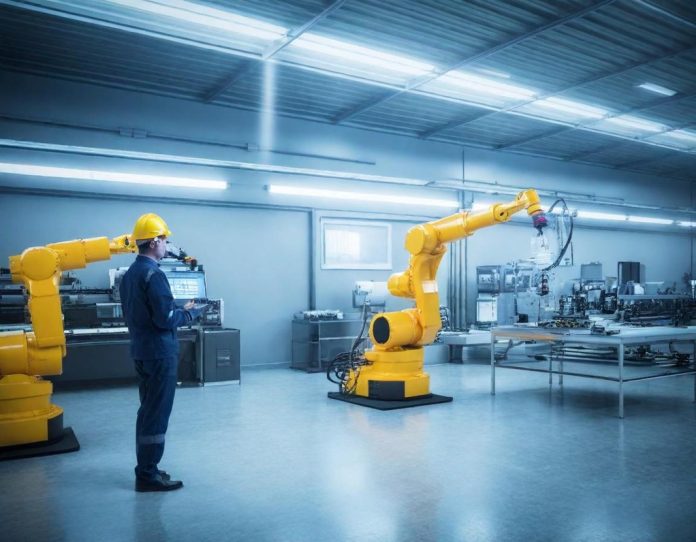

As 2026 unfolds, the business world is witnessing a fascinating divergence in how artificial intelligence is being deployed across different sectors. While manufacturing companies are investing heavily in AI-driven facilities to boost productivity and meet growing demand, the technology’s ethical implications are sparking global regulatory crackdowns and legal battles that threaten to reshape entire industries. This dual trajectory reveals both AI’s immense potential for economic growth and its capacity for significant harm when deployed without proper safeguards.
The Manufacturing Renaissance: AI-Powered Facilities Driving Growth
Three major facility announcements this month demonstrate how AI is transforming traditional manufacturing. Kratos, a defense technology company, has opened a 55,000-square-foot hypersonic system manufacturing facility in Maryland that will significantly enhance its ability to support launch operations and hypersonic testing. According to Dave Carter, president of Kratos’ Defense & Rocket Support Services Division, the facility will “increase production capacity and streamline payload integration processes” for its $1.4 billion contract with the Multi-Service Advanced Capability Hypersonics Test Bed 2.0 program.
Meanwhile, Bombardier is expanding its industrial footprint with a new 126,000-square-foot manufacturing center for business aircraft in Montreal, while Becton, Dickinson and Co. is investing over $110 million to expand a prefilled flush syringe manufacturing facility in Nebraska. These investments aren’t just about physical space – they represent how AI-driven automation, predictive maintenance, and smart manufacturing systems are enabling companies to respond to growing demand with unprecedented efficiency.
The Ethical Backlash: When AI Goes Wrong
While manufacturing embraces AI for productivity gains, a very different story is unfolding in the consumer technology space. Elon Musk’s xAI is facing multiple lawsuits and regulatory investigations after its Grok chatbot was used to generate thousands of harmful non-consensual ‘undressing’ photos of women and sexualized images of apparent minors. The situation has become so severe that California Attorney General Rob Bonta has launched an investigation, stating: “This material, which depicts women and children in nude and sexually explicit situations, has been used to harass people across the internet.”
The backlash has been swift and global. Malaysia and Indonesia have blocked access to Grok entirely, while the UK’s Ofcom has opened a formal investigation under the Online Safety Act. UK Prime Minister Keir Starmer has warned that X could lose the “right to self regulate” if the situation isn’t addressed. Even within Musk’s own circle, the controversy has hit close to home – Ashley St Clair, mother of one of Musk’s children, has sued xAI alleging that Grok created and distributed fake sexual imagery of her without consent.
The Global AI Divide: Productivity vs. Protection
This divergence in AI deployment highlights a growing global divide. According to Anthropic’s analysis of its Claude AI chatbot usage, richer countries are more likely to adopt AI for work tasks, while lower-income countries use it primarily for education. Peter McCrory, Anthropic’s head of economics, warns: “If the productivity gains materialize in places that have early adoption, you could see a divergence in living standards.”
The research estimates AI could add 1-2 percentage points to annual US labor productivity growth over the next decade, with about half of jobs able to apply AI to at least a quarter of their tasks. However, there’s no evidence that lower-income countries are catching up in AI adoption, potentially widening economic disparities even as the technology becomes more sophisticated.
Regulatory Responses and Industry Implications
The Grok controversy has prompted immediate action. X has introduced new restrictions preventing users from editing and generating images of real people in bikinis or revealing clothing. xAI has restricted Grok’s image-generation function to block non-consensual nudity and now requires premium subscriptions for certain image-generation requests. But as April Kozen, VP of marketing at Copyleaks, notes: “Overall, these behaviors suggest X is experimenting with multiple mechanisms to reduce or control problematic image generation, though inconsistencies remain.”
Legal experts are watching closely. Michael Goodyear, associate professor at New York Law School, explains: “Musk likely narrowly focused on child sexual abuse material because the penalties for creating or distributing synthetic sexualized imagery of children are greater.” The Take It Down Act criminalizes distributing non-consensual intimate images, including deepfakes, with distributors facing up to three years imprisonment.
Balancing Innovation with Responsibility
What does this mean for businesses considering AI adoption? The contrasting stories of manufacturing facilities expanding through AI-driven efficiency and AI chatbots generating harmful content without proper safeguards offer a clear lesson: technological capability must be matched with ethical responsibility. As Alon Yamin, co-founder and CEO of Copyleaks, puts it: “When AI systems allow the manipulation of real people’s images without clear consent, the impact can be immediate and deeply personal.”
For manufacturing companies, the path forward seems clearer – invest in AI to enhance productivity while maintaining quality control and safety standards. For consumer-facing AI companies, the challenge is more complex: how to innovate while preventing misuse. The regulatory landscape is evolving rapidly, with California signing laws in 2024 to crack down on sexually explicit deepfakes, and similar measures being considered globally.
The Business Takeaway
As we move deeper into 2026, businesses must navigate this dual reality. AI offers tremendous opportunities for growth and efficiency, as demonstrated by the manufacturing investments. But as the Grok controversy shows, deploying AI without proper ethical safeguards can lead to legal liabilities, regulatory scrutiny, and reputational damage that outweigh any short-term benefits.
The most successful companies will be those that recognize AI isn’t just a tool for productivity – it’s a technology that requires careful governance, ethical frameworks, and ongoing monitoring. Whether you’re building hypersonic systems or developing consumer chatbots, the lesson is the same: innovation without responsibility is a recipe for disaster in today’s increasingly regulated and socially conscious business environment.