

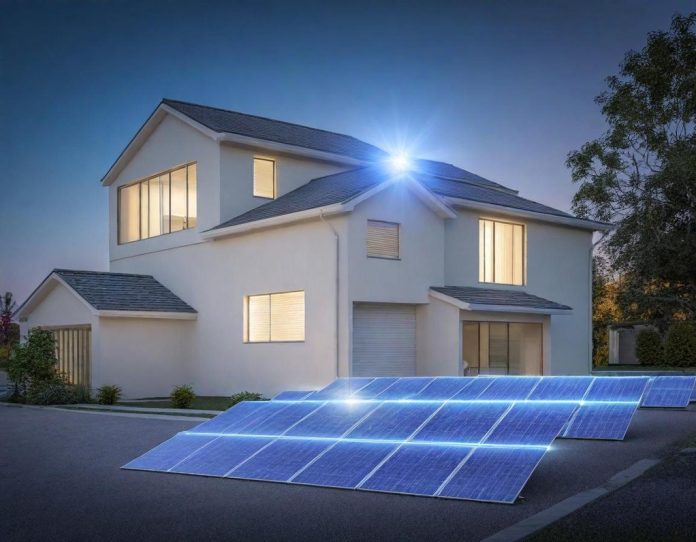

Imagine a future where your home doesn’t just consume electricity – it actively manages it, buying low, storing energy, and selling high, all while keeping the lights on during blackouts. This isn’t science fiction; it’s the reality unfolding in American households as artificial intelligence quietly revolutionizes energy management through home battery systems. What started as backup power solutions are becoming sophisticated energy arbitrage platforms, fundamentally changing how businesses and homeowners interact with the grid.
The Economics of Energy Autonomy
Recent storms that left millions without power highlighted the grid’s fragility, but the real story isn’t about outages – it’s about economics. Home battery systems, once seen as expensive luxuries, are becoming strategic investments that can cut electricity bills by 80% in some cases. James, a homeowner in Los Angeles, explains: “For me, the battery isn’t really about backup. It’s about staying off the grid during the most expensive hours. Solar powers the house during the day, charges the battery, and then at night we run mostly off the battery. It’s cut our grid usage by about 80% and lowered our bill by roughly $150 to $200 a month.”
This transformation from passive rate payer to active energy manager represents a fundamental shift in energy economics. In states like California and Texas, where electricity rates from 4 p.m. to 9 p.m. can be more than double off-peak rates, batteries enable what financial experts call “energy arbitrage” – buying electricity when it’s cheap and using stored energy when prices peak. The implications extend far beyond individual savings, potentially reshaping utility business models and grid management strategies.
The AI Connection: From Simple Storage to Smart Management
What makes modern home batteries different from traditional backup systems is the intelligence layer. While the primary source focuses on hardware costs ($10,000 to $20,000 after installation) and basic scheduling, the real innovation lies in the AI algorithms that optimize energy flow. These systems don’t just store electricity – they predict usage patterns, analyze weather forecasts, monitor grid conditions, and automatically switch between power sources to maximize savings.
This technological evolution mirrors broader AI trends affecting other industries. Just as financial services companies face disruption from AI tools like Altruist’s Hazel platform – which triggered stock declines for Charles Schwab (down 7.8%) and Raymond James (down 8.8%) by automating tax-planning tasks – energy companies must adapt to AI-driven energy management. The parallel is striking: in both sectors, AI is shifting control from centralized institutions to distributed, intelligent systems.
Broader Implications: From Home Labs to Global Markets
The home battery revolution connects to larger technological shifts. Consider the growing popularity of home labs using Linux server distributions like Ubuntu Server and Debian for various computing needs. Just as these systems give users control over their computing environment, home batteries provide energy autonomy. Both trends reflect a broader movement toward decentralization and self-sufficiency enabled by smarter technology.
This decentralization has geopolitical implications too. Europe’s push for AI independence, exemplified by French startup Mistral’s revenue soaring from $20 million to over $400 million annually, shows how nations are seeking technological sovereignty. Similarly, home batteries represent energy sovereignty at the household level, reducing dependence on centralized utilities and vulnerable grid infrastructure.
The Business Case: More Than Just Backup Power
Research from Habitelligence reveals that while outage protection remains the primary driver for adding battery systems, emotional and practical factors are gaining importance. Homeowners increasingly value the ability to “keep what they catch” – storing their own solar energy rather than exporting it to the grid for potentially diminishing credits. Mario, a Houston homeowner, captures this sentiment: “What changed my perspective was realizing I could store the energy my system produces and use it for my own home instead of constantly relying on the utility. Now the money is going into infrastructure I own rather than just paying an electric bill. That feels like a real investment in my home.”
The financial calculus varies by location. Three key factors determine whether a battery makes economic sense: frequency and duration of outages, electricity pricing volatility (particularly time-of-use rates), and solar export credit structures. In regions with favorable conditions, the return on investment can be compelling, transforming batteries from luxury items into strategic assets.
Counterbalancing Perspectives: The Limits and Challenges
Not all perspectives are uniformly optimistic. The high upfront costs ($10,000-$20,000+) remain prohibitive for many homeowners, and the economics depend heavily on local utility policies that can change unexpectedly. Some experts caution that widespread battery adoption could create new grid management challenges, as utilities lose visibility into distributed energy resources.
Furthermore, the environmental impact of battery production and disposal raises questions about the sustainability of mass adoption. While batteries enable greater renewable energy use, their manufacturing involves resource extraction and energy-intensive processes that must be considered in any comprehensive environmental assessment.
The Future: Grid-Interactive Buildings and Market Transformation
Looking ahead, home batteries represent just the beginning of a larger transformation. As these systems become more sophisticated, they could participate in virtual power plants – aggregated networks of distributed energy resources that utilities can dispatch during peak demand. This would turn homes from mere consumers into grid assets, creating new revenue streams for homeowners while enhancing grid stability.
The parallel with AI industry trends is instructive. Just as xAI’s recent challenges – including co-founder departures and controversies over its Grok chatbot – highlight the growing pains of AI development, the home battery sector faces its own maturation challenges. Both fields must balance rapid innovation with reliability, safety, and ethical considerations.
Ultimately, the rise of intelligent home batteries represents more than just a new product category. It signals a fundamental shift in how we produce, store, and consume energy – a shift enabled by artificial intelligence and driven by economic incentives, technological advancement, and changing consumer expectations. As these systems become more affordable and intelligent, they could transform not just individual homes but entire energy markets, creating a more resilient, efficient, and decentralized grid for the AI age.