

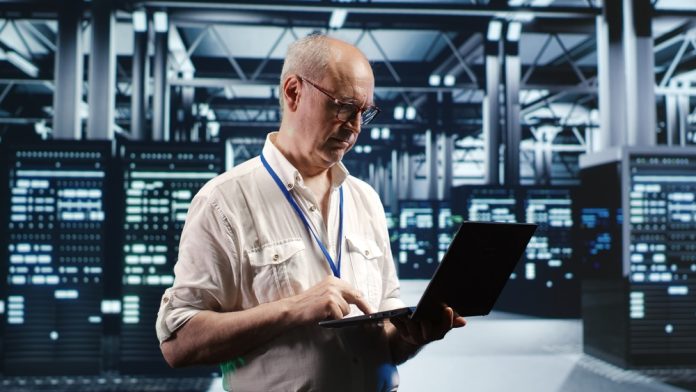

Imagine building the world’s most advanced AI systems, only to realize you can’t store the data needed to train them. That’s the reality facing tech giants today as hyperscalers like Amazon, Google, Microsoft, Meta, and OpenAI have already purchased nearly all available hard disk drives (HDDs) for 2026, creating a supply crunch that’s rippling through the entire technology ecosystem. Western Digital and Seagate, two of the three remaining HDD manufacturers, confirmed their production capacity for 2026 is completely or nearly sold out, with some orders extending into 2028.
The Storage Squeeze
Western Digital CEO Tiang Yew Tan revealed: “We are pretty much sold out for calendar year 2026. We have firm orders from our seven largest customers for the entire calendar year 2026.” Seagate CEO William Mosley added that their Nearline server-focused HDD capacity is fully allocated through 2026, with discussions already underway for 2028 demand forecasts. This isn’t just about storage – it’s about the fundamental infrastructure needed to power the AI revolution.
The Power Problem
While storage shortages grab headlines, a more fundamental bottleneck is emerging: power. New AI data centers require 100 times more electricity relative to their size than they did just a decade ago, according to Financial Times analysis. This has triggered a massive infrastructure overhaul, with companies switching to 800-volt systems – enough to charge a luxury sports car in 20 minutes – and completely rethinking how data centers distribute electricity.
Nvidia’s ambitious plan involves removing power units from server racks entirely and distributing electricity from room perimeters, freeing up valuable compute space. This shift is creating opportunities for industrial companies like Switzerland’s ABB, which supplies technology to one in four data centers, and France’s Legrand, which expects 10-15% sales growth from data center electrification components.
The Energy Efficiency Race
The power challenge has become so critical that it’s attracting significant investment in energy-saving technologies. Indian startup C2i Semiconductors recently secured $15 million in Series A funding to develop system-level power solutions that could cut data center energy losses by around 10%. “If you can reduce energy costs by, call it, 10 to 30%, that’s like a huge number. You’re talking about tens of billions of dollars,” said Rajan Anandan, Managing Director at Peak XV Partners, which led the funding round.
Current power conversion in data centers wastes about 15-20% of energy, and with data-center energy demand projected to nearly triple by 2035 according to BloombergNEF, every percentage point of efficiency matters. C2i co-founder and CTO Preetam Tadeparthy notes: “What used to be 400 volts has already moved to 800 volts, and will likely go higher.”
The Global Competition
This infrastructure race isn’t just happening in Silicon Valley. India is making a massive push to build domestic AI capabilities, with Blackstone backing AI infrastructure startup Neysa with up to $1.2 billion in financing. Neysa plans to expand from about 1,200 GPUs to over 20,000, addressing what Blackstone estimates could grow from under 60,000 GPUs in India today to over 2 million in coming years.
Meanwhile, China’s economic phenomenon of ‘involution’ – intense corporate competition driven by government subsidies – is beginning to affect AI and robotics sectors. Thousands of Chinese AI companies have sprung up to take advantage of government funding, potentially leading to overcapacity similar to what happened with electric vehicles. Yanmei Xie, senior associate fellow at the Mercator Institute for China Studies, warns that this could distort global markets: “Local governments are ordered to set price floors in procurement to fight involution… essentially they’re saying the local government has to spend more than necessary.”
The Innovation Response
Companies are responding to these challenges with innovative solutions. Cisco is exploring Project Edison, which aims to transmit up to 600 watts of direct current over a single wire pair – far beyond today’s 100-watt Power-over-Ethernet maximum. “It will no longer be enough to just distribute data – energy distribution must also become decentralized and as loss-free as possible,” explained Denise Lee, Vice President of Cisco’s Engineering Sustainability Office.
The storage shortage is also driving price increases across the board. In Germany, HDD prices have risen 20-50% since mid-2025, while many SSD models have become about 50% more expensive. Smaller SSD manufacturers without their own memory production are seeing price increases of 200-300%.
The Bigger Picture
What does this mean for businesses and professionals? First, AI infrastructure costs are rising significantly, which could slow adoption for smaller companies. Second, we’re seeing a shift from pure software innovation to hardware and infrastructure innovation – the “plumbing” of AI is becoming as important as the algorithms themselves. Third, geographic competition for AI infrastructure is intensifying, with India and China making strategic moves.
The most successful companies in the AI era won’t just have the best algorithms – they’ll have mastered the complex dance of hardware, power, and global supply chains. As one industry observer noted: “Rethinking the boiler rooms of AI lacks glamour but is big on impact – comparable to ditching the modem and accompanying cluster of wires and switches for WiFi, only on a much larger scale.”
For professionals, this means understanding that AI’s future isn’t just about coding – it’s about energy efficiency, hardware optimization, and global supply chain management. The students worrying that AI will make their degrees obsolete might consider that electricians and infrastructure specialists could be in higher demand than ever before.