

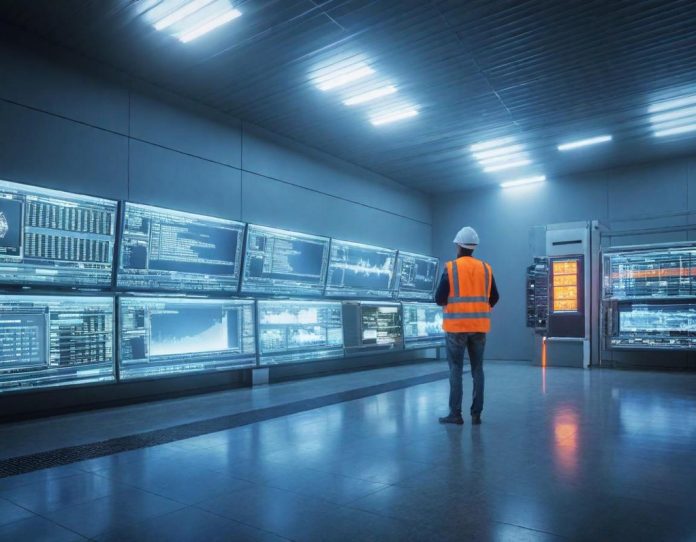

Imagine a single valve in a massive industrial plant. To most, it’s just another piece of machinery. But to companies like CVector, that valve represents thousands of dollars in potential savings – if only someone could connect its operation to the bottom line. This New York-based AI startup just raised $5 million to build what it calls an “industrial nervous system,” and its timing couldn’t be more critical for manufacturers navigating today’s volatile economy.
The Operational Economics Revolution
CVector’s founders, Richard Zhang and Tyler Ruggles, describe their approach as “operational economics” – positioning their AI software between plant operations and financial margins. Their system is already running with customers ranging from public utilities to advanced manufacturing facilities, including ATEK Metal Technologies, an Iowa-based company making aluminum castings for Harley-Davidson motorcycles. The AI helps spot potential equipment downtime, monitors energy efficiency, and tracks commodity prices impacting raw material costs.
“One of the core things we’re witnessing,” Zhang told TechCrunch, “is customers really lack the tool to translate a small action, like turning on and off a valve, [into] did that just save me money?” This gap between operational data and financial insight has become increasingly costly as manufacturing environments grow more volatile with tariff uncertainty, supplier instability, and fluctuating demand.
The Bigger Picture: Manufacturing’s AI Evolution
CVector represents the next phase in manufacturing’s AI journey. According to Manufacturing Dive analysis, while manufacturers have invested heavily in AI across product design, production planning, quality control, maintenance and supply chain operations, finance departments still struggle to influence outcomes in real-time due to visibility gaps. Modern manufacturing systems excel at recording what has already happened but rarely help finance see cost and performance shifts early enough to intervene.
“Margin erosion rarely stems from single failures but accumulates through patterns that are easy to miss in isolation,” the analysis notes. This is where platforms like CVector’s come in – applying intelligence across complete financial and operational datasets to surface emerging risks, anomalies, and performance drift early enough for meaningful intervention.
The Human Factor in an Automated World
As AI transforms industrial operations, questions emerge about its broader economic impact. The Financial Times reports that workers now take home only 53.8% of America’s economic output, the lowest since records began in the 1940s, down from around 65% in the 1950s. AI is contributing to this declining labor share similar to how software adoption did in the 1990s.
Tim O’Reilly, founder of O’Reilly Media, offers a crucial perspective: “The narrative from the AI labs is that when they build artificial general intelligence (AGI), it will unlock astonishing productivity and GDP will surge. It sounds compelling, especially if you’re the one building or investing in AI. But an economy isn’t just production. It is production matched to demand, and demand requires broadly distributed purchasing power.”
Geopolitical Pressures and Supply Chain Realities
The industrial AI landscape operates within complex geopolitical constraints. The Trump administration’s recent $1.6 billion investment in USA Rare Earth represents just one move in a broader push to reduce China’s dominance over critical minerals essential to everything from smartphones to defense technologies. China processes around 90% of the world’s rare earths, creating vulnerabilities for U.S. manufacturers.
Meanwhile, Chinese robotics companies are rushing to go public, with Chinese companies accounting for more than half of all humanoid robot exhibitors at CES 2026. China’s manufacturing system allows quick movement in robotics through dense, coordinated supply chains, though US restrictions on hardware create weaknesses in frontier research and advanced materials.
The Future of Industrial Intelligence
Zhang notes a significant shift in customer attitudes: “When we first started the company almost exactly a year ago, it was still like a taboo to talk about AI in general. There was a 50/50 chance if the customer would embrace AI or just kind of discredit you. But now, over the especially last six months, everyone is asking for more AI-native solutions, even when sometimes the ROI calculation might not be clear. This kind of adoption craze is real.”
Ruggles adds that CVector’s appeal comes down to one thing: money. “We’re at this time when companies are really intimately worried about their supply chain and the costs and variability there, and being able to kind of layer AI on top [to make] economic model of a facility, it’s really resonated with a lot of customers.”
As industrial AI matures, the challenge becomes balancing efficiency gains with broader economic stability. The companies that succeed will be those that not only optimize operations but also consider how their technology affects workers, supply chains, and the delicate balance between production and demand in an increasingly automated world.