

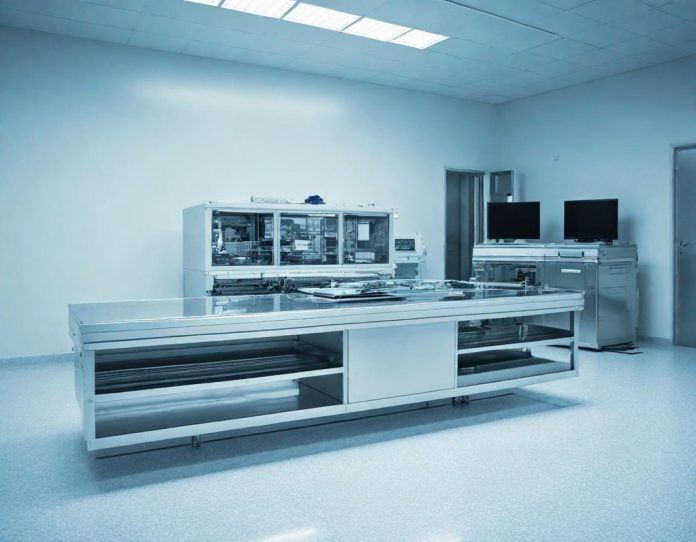

Imagine a company that sells just 40 machines a year, each costing over $220 million, yet is valued at more than $500 billion. That’s ASML, the Dutch company that has become the most powerful player in the artificial intelligence supply chain – and there’s no challenger in sight. While chipmakers like TSMC and Samsung grab headlines with their AI-driven revenue growth, ASML operates in a league of its own as the sole supplier of extreme ultraviolet (EUV) lithography machines needed to produce the world’s most advanced semiconductors.
The Technology That Defies Competition
What makes ASML’s monopoly so unassailable? The technology behind EUV machines involves a chain of near-impossible steps that all must work simultaneously. Engineers create light that doesn’t occur naturally by firing powerful lasers at microscopic droplets of molten tin, generating plasma hotter than the Sun’s surface. This EUV light then reflects off mirrors made with atomic-level precision before transferring patterns onto silicon wafers. The optics alone – produced exclusively by Carl Zeiss SMT – represent decades of tightly integrated development that no competitor can replicate overnight.
Why Second Place Doesn’t Work
The economics of EUV lithography create an insurmountable barrier to entry. Any new competitor would face a catch-22: they’d sell too few machines to recover development costs, yet those machines would need near-perfect reliability from day one. Consider TSMC, which generates over $120 billion in annual sales. A single day of lost production across its fabrication plants can cost hundreds of millions of dollars. Chipmakers simply cannot afford to experiment with unproven EUV tools in volume production, which means a rival would never accumulate the field data needed to improve.
ASML shipped its first EUV machine in 2006 and its first production-capable system in 2013. Today, cumulative operating hours run into the millions as chip factories operate around the clock. This gap in real-world experience explains why Nikon and Canon abandoned EUV development over a decade before it became commercially viable – and why no successor has emerged since.
The Geopolitical Context: Trade Tensions and Investment Gaps
While ASML’s technological dominance appears secure, broader geopolitical and economic factors create additional complexity for the AI chip ecosystem. Recent trade tensions between the U.S. and Europe, including threats of tariffs over Greenland acquisition attempts, highlight how political decisions can ripple through global supply chains. The European Parliament’s planned suspension of a U.S. tariffs deal, following threats of levies on eight European countries, demonstrates how quickly trade relationships can deteriorate.
These tensions occur against a backdrop of significant investment challenges. Europe faces a �3 trillion financing gap for its AI, data center, and energy infrastructure ambitions over the next five years, according to Financial Times analysis. The continent lacks the depth of long-dated investment capital available in the U.S., with underdeveloped securitization markets and restrictive Solvency II rules for insurers. While private credit fundraising in Europe rose 40% last year, the U.S. data center debt securitization totaled $63.6 billion since 2018 compared to just $0.8 billion in the EU.
The Global Economic Stakes
The International Monetary Fund warns that the global economy’s resilience is at risk if the AI boom falters. In its updated World Economic Outlook, the IMF notes that growth has become overly reliant on AI investment in the U.S. technology sector. A drop in AI investment could reduce global growth by about 0.4 percentage points in 2026, according to IMF chief economist Pierre-Olivier Gourinchas.
“There is a risk of a correction, a market correction, if expectations about AI gains in productivity and profitability are not realized,” Gourinchas stated. “We’re not yet at the levels of market frothiness that we saw in the dotcom period. But nevertheless there are reasons to be somewhat concerned.”
Industry Responses and Strategic Shifts
Chipmakers are navigating this complex landscape with mixed strategies. TSMC reported 2025 net revenue of $122.4 billion, a 35.9% increase driven by AI demand, with high-performance computing accounting for 58% of revenue. The company is expanding its Arizona manufacturing footprint with six advanced fabs, supported by a $100 billion additional U.S. investment.
Meanwhile, U.S. chipmakers offer calculated support for recent tariffs on advanced AI semiconductors, despite higher costs. Nvidia praised a 25% tariff decision for “supporting American jobs and manufacturing,” while industry association SEMI warned of supply chain impacts. The U.S. government has taken direct stakes in the industry, including a 10% ownership in Intel valued at $8.9 billion.
The Physical AI Revolution
Beyond chip manufacturing, the convergence of AI and robotics – termed “physical AI” – is transforming industries from healthcare to logistics. Over 4.7 million industrial robots were in operation in 2024, with annual installation growth exceeding 500,000 units. China accounted for 54% of all new robots installed, while healthcare showed nearly twice as many new installations compared to the previous year.
“AI-enabled robots that pick and place different parts and materials in our assembly lines reduce automation costs by 90 percent,” said Stephan Schlauss, global head of manufacturing at Siemens. “Manual workers are also empowered with AI-guided systems, enhancing productivity and quality.”
The Unbreakable Monopoly’s Implications
ASML’s dominance demonstrates how, beyond a certain technological threshold, markets no longer correct monopolies. Even China’s heavily funded efforts to develop domestic chipmaking equipment have failed to produce a credible EUV alternative, despite treating semiconductor manufacturing as a national priority since 2020 export controls.
This creates both stability and vulnerability in the AI supply chain. On one hand, ASML’s proven reliability ensures consistent production of advanced chips. On the other, the lack of alternatives means geopolitical tensions or production disruptions could have catastrophic consequences for global AI development. As the IMF warning suggests, the world’s economic resilience increasingly depends on technologies flowing through this single company’s machines – making ASML not just a chip equipment manufacturer, but a critical infrastructure provider for the AI age.