

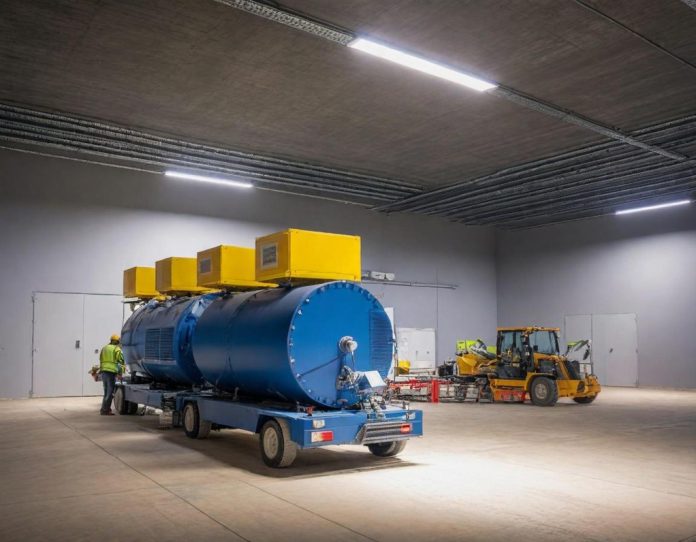

Caterpillar’s record-breaking fourth quarter might seem like just another corporate earnings story, but dig deeper and you’ll find it’s a powerful indicator of how artificial intelligence is reshaping entire industries in unexpected ways. While tech companies pour billions into AI development, traditional manufacturers like Caterpillar are reaping the benefits of the infrastructure boom that AI demands.
The Power Behind the AI Revolution
Caterpillar reported record sales of $19.1 billion in Q4 2025, driven by a 23% surge in its power and energy segment. CEO Joe Creed revealed the company is now in weekly conversations with hyperscalers and large data center customers, positioning itself as “one of the fastest solutions out there for data centers who are trying to get up and running quickly.” This isn’t just about selling generators – it’s about becoming an essential partner in the AI infrastructure race.
The company’s recent deal to supply two-gigawatt generators for a multibillion-dollar data center development in West Virginia exemplifies this shift. With a record backlog of $51 billion, Caterpillar enters 2026 with strong momentum, expecting 5-7% sales growth despite facing $2.6 billion in incremental tariff costs. Wall Street analysts note that while tariffs are “keeping a lid” on margins, the power and energy business is in a “sweet spot” as data center demand accelerates.
The Tech Pivot: From EVs to Robots
While Caterpillar benefits from AI’s infrastructure needs, tech companies are undergoing dramatic transformations. Tesla reported its first annual revenue decline in 2025, with a 3% drop as the company shifts focus from electric vehicles to AI and robotics. Elon Musk announced plans to end production of Model S and Model X vehicles, repurposing the California manufacturing plant to produce humanoid robots called Optimus.
“A lot of investors asked us to do this,” Musk said about Tesla’s $2 billion investment in his AI venture xAI. “We’re making big investments for an epic future.” This pivot comes as BYD overtook Tesla as the world’s biggest EV maker in January 2025, forcing the company to seek new growth avenues in robotics and AI.
The AI Investment Arms Race
Meta’s announcement that capital expenditures could nearly double to $135 billion this year highlights the staggering scale of AI investment. CEO Mark Zuckerberg is intensifying the push to develop ‘personal superintelligence’ despite investor concerns that previously led to an 11% share price drop. Similarly, Microsoft reported capital expenditure surging 66% to $37.5 billion, with about two-thirds spent on short-lived assets like GPU and CPU chips to support its data center business.
Satya Nadella, Microsoft’s CEO, noted: “We are only at the beginning phases of AI diffusion and already Microsoft has built an AI business that is larger than some of our biggest franchises.” This infrastructure race between tech giants creates unprecedented demand for the power generation and equipment that companies like Caterpillar provide.
Manufacturing’s Complex Landscape
The broader manufacturing outlook for 2026 presents a complex picture. While investment is ramping up in automation and artificial intelligence, manufacturers face significant headwinds. Caterpillar reported a 9% decline in operating profit to $2.7 billion, with nearly $1 billion impact from manufacturing costs linked to tariffs and $282 million in restructuring costs.
Creed acknowledged that orders within construction and mining segments can be inconsistent or “lumpy,” highlighting the uneven nature of the manufacturing recovery. This volatility comes as the Trump administration aims to bolster domestic investments through tariffs and deregulation, creating both opportunities and challenges for manufacturers.
The Bigger Picture: Physical AI Takes Center Stage
Financial Times analysis points to a broader trend toward ‘physical AI’ and its real-world applications. As Tesla shifts from electric vehicles to robotics and companies like Meta advance AI glasses with built-in displays, the line between digital and physical AI applications blurs. HSBC estimates the total addressable market for smart glasses could reach about $200 billion by 2040, indicating massive growth potential beyond traditional computing applications.
What does this mean for businesses and professionals? The AI revolution is creating winners beyond the usual tech suspects. Traditional manufacturers who can provide essential infrastructure, power solutions, and equipment for data centers and AI operations stand to benefit significantly. Meanwhile, tech companies face the challenge of justifying massive capital expenditures while navigating shifting market dynamics and competitive pressures.
The question isn’t whether AI will transform industries – it already is. The real question is which companies will successfully navigate this transition, and whether traditional manufacturers can maintain their momentum as AI infrastructure demands continue to grow. With Caterpillar’s record backlog and tech companies’ massive investments, 2026 promises to be a pivotal year in defining AI’s physical footprint across the global economy.