

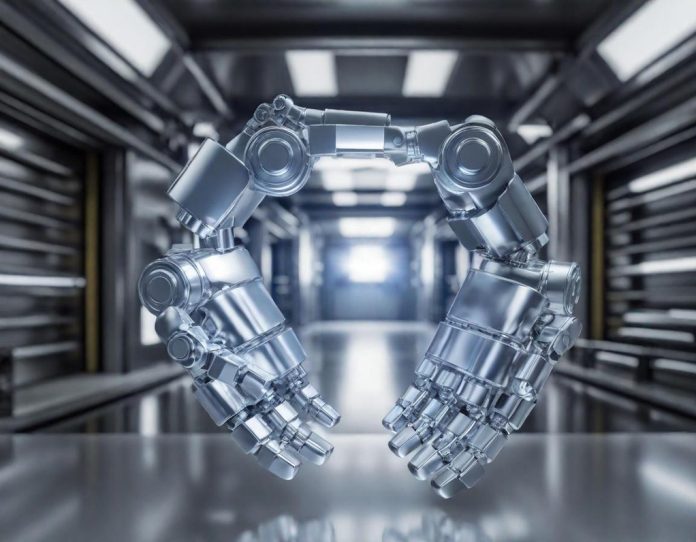

Imagine a robot that can fold your laundry, fix a vacuum cleaner, and sort auto parts – all with 99% reliability. That’s not science fiction anymore. Generalist’s new GEN-1 physical AI model has crossed what the company calls “production-level success rates,” achieving 99% reliability on delicate mechanical tasks like folding boxes, packing phones, and servicing robot vacuums. But is this the breakthrough moment for physical AI, or just another case of AI hype outpacing reality?
The Data Problem Solved
What makes GEN-1 different from previous robotic systems? The answer lies in data. While large language models have trillions of words from the internet to learn from, robotic models lack similar quality data about how humans manipulate objects. Generalist solved this with “data hands” – wearable pincers that capture micro-movements and visual information as humans perform manual tasks. The company has collected over half a million hours and petabytes of physical interaction data, creating what might be the most comprehensive physical AI training dataset to date.
Beyond Pre-Programming
Traditional robotic systems rely on carefully pre-programmed motions or single-task training. GEN-1 breaks this mold by improvising based on previous experience. In one demonstration, the model gave a plastic bag a little shake to get a plush toy inside – a move never explicitly programmed. Another video shows robot hands adjusting intelligently as flexible objects spring out of position or refolding a shirt that gets moved mid-task. “Nobody has programmed the robot to make mistakes, therefore nobody has programmed the robot to recover from mistakes,” says Generalist engineer Felix Wang. “And that just happens for free.”
The Hype vs. Reality Check
While Generalist’s claims are impressive, they arrive amid growing concerns about AI overselling. A recent ZDNET analysis reveals that even the best AI coding models succeed less than 23% of the time on real production code, with benchmark scores averaging 85% but real-world success dropping to 17% on production maintainability tasks. AI expert David Linthicum warns: “AI is being vastly oversold. Only with a clear-eyed, evidence-driven perspective can we move past the hype and ensure that technology serves business, not the other way around.”
The Data Infrastructure Challenge
Even if GEN-1 performs as advertised, scaling physical AI faces another hurdle: data management. Nomadic AI, a startup that just raised $8.4 million, focuses on solving exactly this problem. Their platform uses vision language models to organize and catalog video data from autonomous vehicles and robots, turning footage into structured, searchable datasets. As Nomadic CEO Mustafa Bal explains: “We are providing folks insight on their own footage, whatever drives their own AVs [and] robots. That is what moves these autonomous systems builders forward, not random data.”
Industry Implications
For businesses, GEN-1’s 99% reliability could be transformative. Manufacturing, logistics, and maintenance operations that rely on repetitive but delicate tasks could see significant efficiency gains. The model’s ability to adapt after just one hour of specific training means faster deployment and lower implementation costs. However, companies must weigh these potential benefits against the reality check from AI performance studies and consider whether they have the data infrastructure to support such systems.
The Competitive Landscape
Generalist isn’t alone in the physical AI race. Google’s Gemini Robotics models can understand and respond to general action prompts, while Physical Intelligence has trained robotic hands in simulated household environments. Even Tesla’s Optimus robots, despite Elon Musk admitting they’re still not doing “useful work” at Tesla factories, represent significant investment in this space. The difference with GEN-1, according to Generalist, is reaching that GPT-3-style inflection point where tasks cross “the level of performance needed to be deployed in economically useful settings.”
What This Means for Professionals
For professionals in robotics, manufacturing, and AI development, GEN-1 represents both opportunity and caution. The opportunity lies in finally having physical AI systems that can handle complex, variable tasks with human-like adaptability. The caution comes from remembering that real-world performance often lags behind demonstrations and benchmarks. As companies consider implementing such systems, they should ask: Do we have the data infrastructure to support this? Are we prepared for the integration challenges? And most importantly, are we buying into the promise or the proven performance?
The Path Forward
Generalist’s achievement with GEN-1 suggests we’re approaching a new era for physical AI. But the journey from demonstration to widespread adoption will depend on several factors: continued improvements in reliability, better data management solutions like those offered by Nomadic AI, and a more realistic assessment of AI capabilities across industries. As Schuster Tanger, Partner at TQ Ventures, notes about data infrastructure: “It’s the same reason Salesforce doesn’t build its own cloud and Netflix doesn’t build its own [content distribution facilities]. The second an autonomous vehicle company tries to build Nomadic internally, they’re distracted from what makes them win, which is the robot itself.”
The question isn’t whether physical AI will transform industries – it’s when, and how realistically we approach that transformation. GEN-1’s 99% reliability marks a significant milestone, but the real test will be whether it can maintain that performance outside controlled environments and whether businesses can build the supporting infrastructure to make it work at scale.