

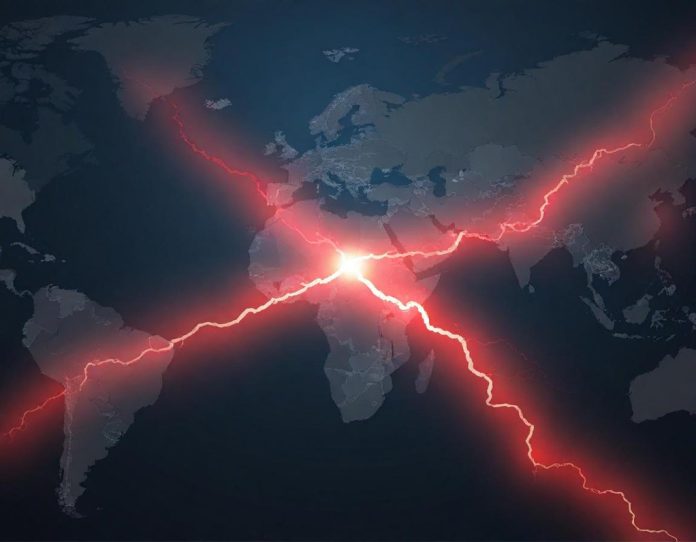

Imagine waking up to find your heating bill has doubled overnight, or that your farm’s fertilizer costs have skyrocketed just as planting season begins. This isn’t a hypothetical scenario – it’s the reality unfolding across the globe as the US-Israel war with Iran triggers what analysts are calling “the biggest supply shock in modern global oil market history.” The conflict has blocked the Strait of Hormuz, a critical chokepoint through which 20% of the world’s crude oil travels, sending energy prices soaring and creating ripple effects that are hitting businesses, industries, and households from Asia to Europe to rural America.
The Scale of the Supply Shock
When oil prices surged above $100 per barrel for the first time since 2022 – with Brent crude jumping 15.5% to $107.16 – it wasn’t just another market fluctuation. This represents a fundamental disruption to global energy flows. Hunter Kornfeind, senior macro energy analyst at Rapid Energy Group, puts it bluntly: “This is essentially the biggest supply shock at least in modern global oil market history. We’re talking apples to oranges in terms of the need.” The situation escalated further when Qatar’s energy minister, Saad al-Kaabi, warned that all Gulf oil and gas production could halt within days if the conflict continues, potentially pushing prices to $150 per barrel.
Asia’s Immediate Response and Risks
Asian nations, heavily dependent on energy imports, have moved swiftly to contain the damage. South Korea announced price caps on petrol products, while Thailand plans to cap diesel prices for 15 days. Vietnam is preparing to temporarily remove taxes on fuel imports, and Bangladesh closed universities to conserve energy. However, experts warn these measures carry risks. Roc Shi from University of Technology Sydney notes that price caps are “politically attractive” as they offer “visible relief,” but risk backfiring if they lead to panic buying and shortages. South Korean President Lee Jae Myung acknowledged the conflict has created a “significant burden” on his country’s economy.
Beyond Oil: The Commodity Chain Reaction
The impact extends far beyond just oil prices. The Middle East is also a major source of aluminum, sulfur (used to process metals like copper), and fertilizer ingredients including urea. As these commodity prices creep higher, the pressure feeds through to manufacturing and agriculture. In the US, about 25% of fertilizer imports arrive in March and April during planting season, according to the American Farm Bureau Federation. Farmer Harry Ott from South Carolina, who grows cotton, corn, and soybeans, described calling his fertilizer supplier only to be told the business was holding off on sales until it could assess the war’s impact. “These are trying times and what we are going through now on fertilizer… was totally unexpected,” Ott said. “Nobody’s balance sheet had room to make these adjustments.”
Tech Sector Vulnerability
One surprising vulnerability lies in the technology sector. Analysts are watching chip-making closely – a sector with ramifications for everything from cars to smartphones – since Taiwan, a production hub, relies heavily on energy imports. More concerning for economic growth drivers: some experts warn that a jump in energy costs could weigh on tech firms trying to build out their artificial intelligence infrastructure. As AI development requires massive computational power and energy consumption, rising energy prices could slow innovation in one of the economy’s most dynamic sectors.
Household Impacts and Political Pressure
The human cost is becoming painfully clear. In Cornwall, UK, heating oil prices have more than doubled from about 62p to �1.30 per liter since the conflict began. Pensioner Pauline Trubody, quoted �724 for 500 liters, asked: “You have to look at the pennies and see how far they stretch and if they don’t stretch, then what do you do?” Similar stories emerge across rural Britain, where heating oil prices have jumped from �600-�700 to �1,258 per 1,000 liters. Dominique Shepherd, a mother of three from near Thirsk, lamented: “If I had just ordered it when it was at �300 things would be a lot simpler, a lot easier. We just don’t have that money lying around.”
Economic and Political Fallout
The economic risks are greatest in Asia and Europe, reflected in stock markets: Japan’s Nikkei 225 fell over 5%, South Korea’s main index dropped roughly 15%, and Germany’s Dax declined more than 7%. In contrast, the US S&P 500 fell just 1.2%. But with cost-of-living concerns mounting ahead of congressional elections in November, analysts say the situation threatens to create political problems for US President Donald Trump should price rises reach consumers. Trump called the oil price rise a “small price to pay” for addressing Iran’s nuclear threat, but the White House has sent conflicting signals about its plans for the region.
The Path Forward
Some countries have discussed releasing oil reserves, but Hunter Kornfeind notes the scale would be “peanuts” compared to demand. Christopher Wong, an OCBC bank strategist, suggests oil prices could unwind “relatively quickly” if tensions ease, but could continue climbing with any disruption to production or shipments. The fundamental question remains: how long can the global economy absorb these shocks before broader slowdowns occur? Goldman Sachs estimates that a temporary rise to $100 per barrel could knock 0.4 percentage points off global economic growth. If the conflict persists, we may be looking at impacts far beyond what any single industry or government can easily manage.