

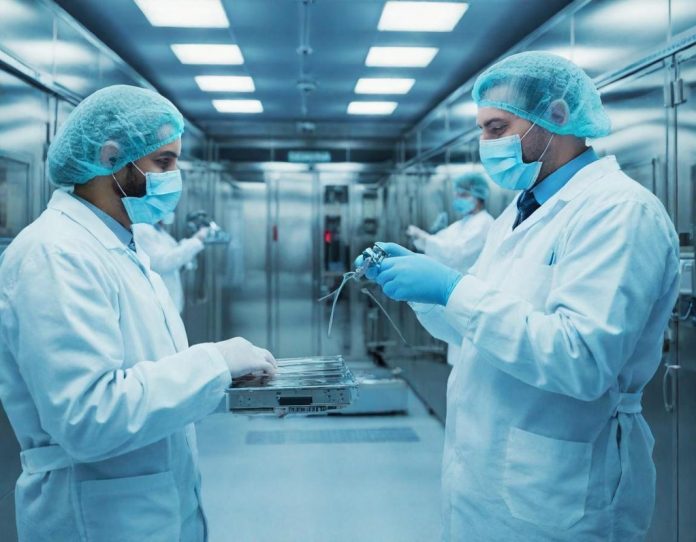

In a move that could fundamentally reshape the global artificial intelligence landscape, Taiwan has committed $250 billion to bolster U.S. semiconductor manufacturing through a landmark trade deal announced Thursday. The agreement, signed by the Trump administration, represents one of the largest foreign investments in American technology infrastructure in decades and comes at a critical moment when only 10% of semiconductors are produced stateside. But what does this massive capital injection mean for the AI industry beyond the headlines, and how does it connect to the broader technological shifts happening right now?
The Semiconductor Deal That Changes Everything
Under the deal announced by the U.S. Department of Commerce, Taiwanese semiconductor and tech companies will make direct investments of $250 billion into the U.S. semiconductor industry, spanning semiconductors, energy, and AI “production and innovation.” Taiwan currently produces more than half of the world’s semiconductors, making this partnership strategically crucial for both nations. The country will also supply an additional $250 billion in credit guarantees for additional investments, though the time period remains unspecified.
In return, the U.S. will invest in Taiwan’s semiconductor, defense, AI, telecommunications, and biotech industries, though specific dollar amounts weren’t disclosed. The timing is significant – the announcement came just one day after the Trump administration published a proclamation reiterating the country’s goal to bring more semiconductor manufacturing back to the United States. “This dependence on foreign supply chains is a significant economic and national security risk,” the proclamation stated, highlighting that semiconductors play a “foundational role” in both the modern economy and national defense.
The Tariff Context and Nvidia’s Position
This semiconductor deal unfolds against a backdrop of escalating trade tensions, particularly around advanced AI chips. The same proclamation that announced the Taiwan partnership also imposed 25% tariffs on some advanced AI chips, including Nvidia’s H200 advanced AI chips headed to China. Despite these tariffs, Nvidia publicly cheered the move, with a spokesperson stating: “We applaud President Trump’s decision to allow America’s chip industry to compete to support high-paying jobs and manufacturing in America.”
The tariff situation reveals a complex balancing act. While the U.S. seeks to protect its domestic industry, there’s significant demand for these chips from Chinese companies, with Nvidia reportedly considering ramping up production due to early orders. China finds itself in a similar yet different situation – wanting to boost its domestic semiconductor industry while not falling behind in the global AI race. The Chinese central government is reportedly working to draft rules about how many semiconductors Chinese companies can purchase from overseas, potentially allowing some purchasing of Nvidia’s chips despite current adversity toward imports.
Beyond Chips: The Physical AI Reality Check
While semiconductor manufacturing grabs headlines, the real-world implementation of AI faces practical challenges that this investment might help address. According to a Financial Times analysis, the commercial realities of robotics and physical AI deployment contrast sharply with the rapid adoption of generative AI like ChatGPT. Recent developments include Nvidia CEO Jensen Huang’s predictions of a ‘ChatGPT moment’ for physical AI, but practical challenges persist.
Case studies reveal implementation barriers that go beyond chip availability. Kroger recently closed three of its eight robotic warehouses in favor of gig economy partnerships, highlighting how automation decisions involve complex business calculations. Warehouse automation expert Tom Andersson notes: “In the end, you need to have a really good business case for why you do automation, and when you do those business cases – because sometimes these projects can take three years in the planning – if your forecast is wrong at that point it will be tricky.”
Physical limitations also constrain deployment. Boston Dynamics’ Spot robot, for instance, can only operate for about 90 minutes before recharging, while human workers commonly work 10-hour shifts with breaks in factories and warehouses. Walmart’s experience shows another dimension – the retail giant increased revenues by over $150 billion over five years while slightly reducing headcount, suggesting that automation’s impact on employment is more nuanced than simple replacement narratives.
The Enterprise AI Evolution
Meanwhile, enterprise AI continues evolving in ways that complement rather than replace human workers. Salesforce has transformed Slackbot, the automated assistant in its Slack messaging platform, into an AI agent powered by generative AI. The new Slackbot, available to Business+ and Enterprise+ customers, can find information, draft emails, schedule meetings, and connect to other enterprise applications like Microsoft Teams and Google Drive. Salesforce CTO Parker Harris described it as a “super agent” that employees will love, noting it has been highly adopted internally.
Similarly, Anthropic has launched Cowork, a new feature in its Claude desktop app that allows users to give the AI access to specific folders on their computer and perform general office tasks through plain language instructions. Built on the same foundations as Claude Code, Cowork is designed to be more accessible to non-technical knowledge workers, with examples including expense report creation, report writing from digital notes, and folder reorganization. These developments suggest that AI’s most immediate impact may be augmenting human capabilities rather than automating entire job categories.
The Knowledge Infrastructure Question
As AI systems become more sophisticated, their relationship with human-generated knowledge becomes increasingly important. The Wikimedia Foundation recently announced new partnerships with Amazon, Meta, Microsoft, Mistral AI, and Perplexity for its commercial product, Wikimedia Enterprise, which allows large-scale reuse and distribution of Wikipedia content. These deals give Wikipedia another way to sustain itself in an age where much of its content is being picked up and reused by AI models.
Wikimedia Foundation’s CPO/CTO Selena Deckelmann noted: “Wikipedia shows that knowledge is human, and knowledge needs humans. Especially now, in the age of AI, we need the human-powered knowledge of Wikipedia more than ever.” This perspective highlights how AI development depends not just on hardware and algorithms, but on the quality of the knowledge it processes – knowledge that remains fundamentally human-curated.
What This Means for Businesses and Professionals
The Taiwan semiconductor deal represents more than just capital investment – it signals a strategic realignment in how nations approach technological sovereignty. For businesses, several implications emerge:
- Supply Chain Resilience: Companies dependent on AI hardware should reassess their supply chain vulnerabilities and consider how shifting manufacturing patterns might affect availability and pricing.
- Investment Opportunities: The $250 billion injection will create opportunities across semiconductor manufacturing, energy infrastructure, and AI innovation ecosystems.
- Strategic Partnerships: As nations collaborate on technology development, businesses may need to navigate increasingly complex geopolitical considerations in their partnerships.
- Workforce Development: The emphasis on domestic manufacturing suggests growing demand for skilled workers in semiconductor production and related fields.
For professionals, the evolving landscape suggests that understanding both the technical capabilities and practical limitations of AI will become increasingly valuable. As physical AI faces commercial reality checks and enterprise tools become more sophisticated, the most successful professionals will be those who can bridge technical understanding with business acumen.
The Taiwan-U.S. semiconductor partnership represents a pivotal moment in the global AI race, but its true significance lies in how it connects to broader technological and commercial realities. From physical AI’s practical constraints to enterprise tools’ augmentative potential, the future of AI depends not just on chips and algorithms, but on how these technologies integrate into real-world systems and human workflows. As investment flows and trade policies shift, businesses and professionals must look beyond the headlines to understand the complex interplay of technology, economics, and strategy shaping the AI landscape.