

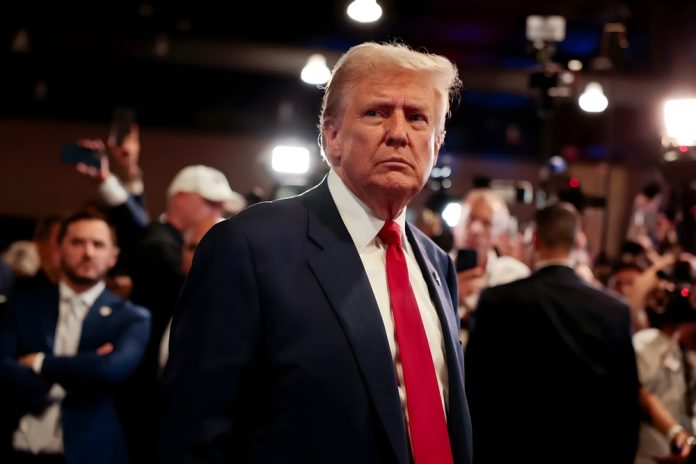

President Donald Trump announced plans this week to sign an executive order establishing a single federal rule for artificial intelligence regulation, aiming to streamline what he calls an “over-regulation” by individual states? In a Truth Social post, Trump argued that requiring companies to navigate 50 different state approvals would hinder U?S? competitiveness against global rivals like China? “You can’t expect a company to get 50 Approvals every time they want to do something,” Trump wrote? “THAT WILL NEVER WORK!”
The Regulatory Battlefield
The proposed order would create an “AI Litigation Task Force” to challenge state AI laws in court and direct federal agencies to evaluate “onerous” state regulations? This move comes after a Senate effort to preempt state AI regulation failed, with Senator Ted Cruz’s proposal for a 10-year moratorium on AI legislation being rejected 99-1? The announcement has ignited immediate bipartisan pushback, with prominent Republicans and MAGA supporters accusing Trump of caving to Big Tech donors?
More than 200 state lawmakers have issued an open letter opposing federal preemption, while over 35 state attorneys general warned Congress that overriding state AI laws could have “disastrous consequences?” Representative Marjorie Taylor Greene (R-GA) emphasized that “States must retain the right to regulate and make laws on AI and anything else for the benefit of their state? Federalism must be preserved?”
China’s Open-Source Advantage
While the U?S? debates regulatory frameworks, China is pursuing a different strategy that could reshape the global AI landscape? According to analysis in the Financial Times, China’s open-source AI approach is becoming a national advantage, with companies like DeepSeek, Alibaba, and Baidu releasing high-performing models that rival U?S? counterparts while using less computing power? DeepSeek’s R1 large language model caused a 3% drop in Nasdaq in January, and developers have created over 500 derivative models from it on Hugging Face, downloaded 2?5 million times?
Former Google CEO Eric Schmidt warned that “U?S? companies risk ceding open-source AI to China completely?” This contrast between China’s collaborative, open-source ecosystem and the U?S?’s closed, venture capital-driven model raises questions about which approach will dominate the future of AI development?
Chip Diplomacy and National Security
In a related development, Trump has given Nvidia the green light to sell its advanced H200 AI chips to approved customers in China, reversing previous restrictions? The decision follows lobbying by Nvidia CEO Jensen Huang and requires Nvidia to pay 15% of its Chinese revenues to the U?S? government? While Trump stated this move “protects National Security, creates American Jobs, and keeps America’s lead in AI,” security experts express concerns?
Cole McFaul, Senior Research Analyst at Georgetown University’s Center for Security and Emerging Technology, noted: “By making it easier for the Chinese to access these high-quality AI chips, you enable China to more easily use and deploy AI systems for military applications?” This decision conflicts with Congressional concerns, as Senators Pete Ricketts and Chris Coons introduced the SAFE Chips Act on December 4, which would block advanced AI chip exports to China for 30 months?
The Practical Impact on Businesses
For technology companies, the regulatory uncertainty creates significant challenges? State laws like California’s SB 53 (AI safety and transparency) and Tennessee’s ELVIS Act (protecting musicians from unauthorized AI-generated deepfakes) represent diverse approaches that would be overridden by federal preemption? Florida Governor Ron DeSantis argued: “I oppose stripping Florida of our ability to legislate in the best interest of the people? A ten year AI moratorium bans state regulation of AI, which would prevent FL from enacting important protections for individuals, children and families?”
The timing is particularly sensitive as AI capabilities advance rapidly? Recent testing by ZDNET comparing Google’s Gemini and Microsoft’s Copilot on everyday tasks revealed significant performance differences, with Gemini outperforming Copilot in areas like travel planning and creative tasks, while Copilot excelled in technical scripting? These practical applications highlight why consistent regulation matters for innovation and user trust?
Global Competition Intensifies
The regulatory debate occurs against a backdrop of intensifying global competition? China’s strategy of releasing open-source models that match the reasoning performance of GPT-5 and Gemini-3 Pro while using less computing power presents a formidable challenge? The top 10 open-source AI models are now almost all Chinese, suggesting a shift in the innovation landscape?
Meanwhile, research published in Science and Nature reveals that AI chatbots can change people’s political preferences more effectively than traditional election advertising, with brief conversations shifting preferences by up to 10 percentage points? This finding underscores the societal impact of AI that regulators must consider?
The Path Forward
As the executive order moves forward, businesses face a complex landscape? The tension between federal standardization and state autonomy reflects deeper questions about how to balance innovation with protection, competition with security, and efficiency with democratic oversight? With China pursuing an alternative model and AI capabilities advancing daily, the decisions made in Washington will reverberate through boardrooms, research labs, and global markets for years to come?
The coming weeks will reveal whether Trump’s “ONE RULE” approach can withstand political opposition and address the multifaceted challenges of AI governance? What’s clear is that in the race for AI supremacy, regulation has become as crucial as innovation?